Picking the right plot shape
Every way of plotting in Ghostkey starts from a shape: the structure the cards come up in, the one the chat proposes, or the one in your head when you write an outline. There are two kinds, and they don’t do the same job.
- Beat sheets give you specific moments, often tied to a genre.
- General book shapes give you a frame and leave it to you to fill it in.
Ghostkey’s card picker sorts them the same way: By genre for the first, Any story for the second.
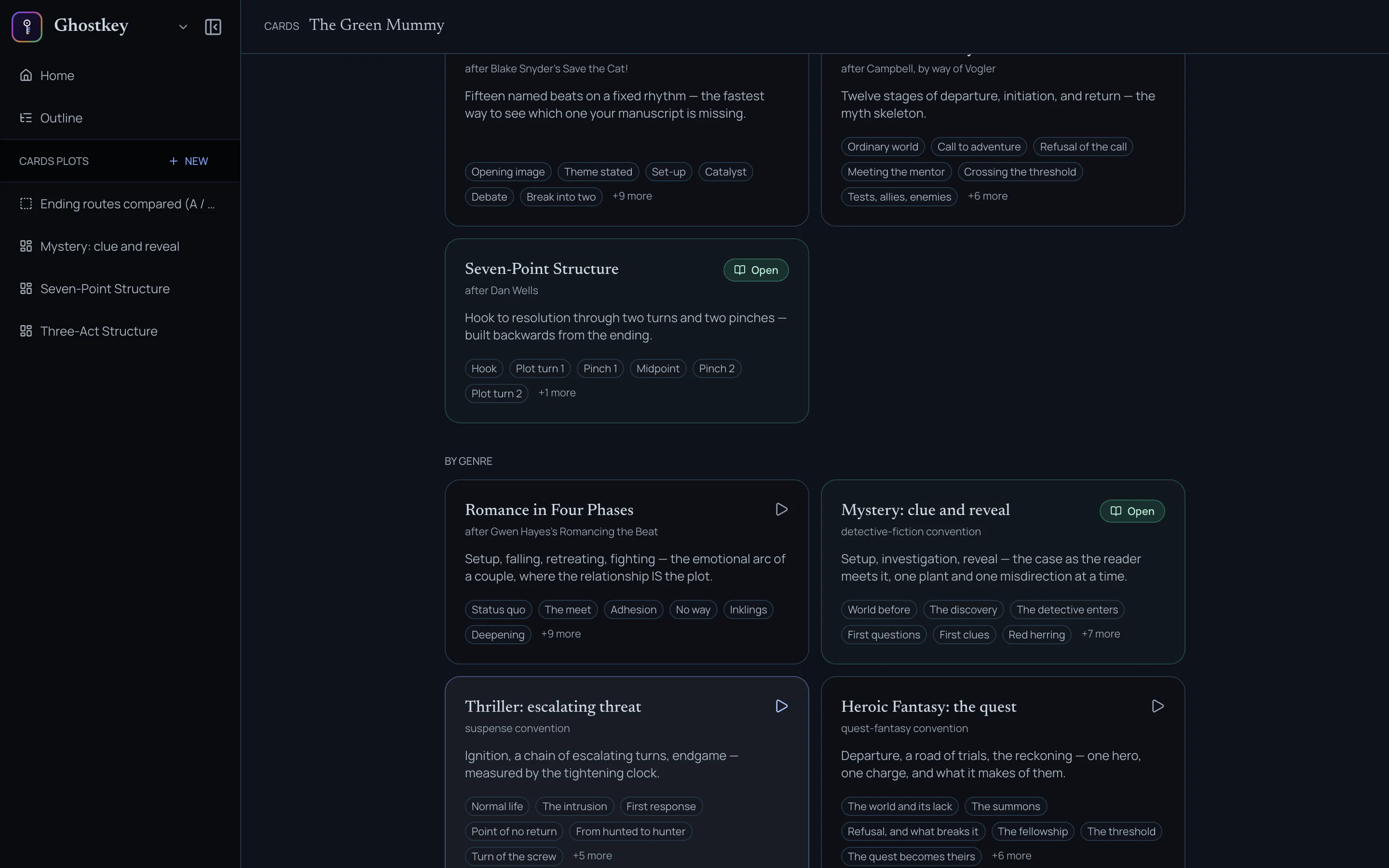
Genre beat sheets
Genre beat sheets are the easier of the two to use. If your genre is well established, a beat sheet hands you the specific moments that make the genre’s emotion land: the meet in a romance, the discovery and the red herring in a mystery, the point of no return in a thriller.
The price is that they can feel restrictive, and they can get repetitive. Think of the mentor’s death in heroic fantasy, or the third-act breakup in a romance. They’ve become so common that avid readers know they’re coming. That doesn’t mean they’ve stopped working. Readers still respond to them, which is why a beat sheet is an easy recipe for a book that’s easy to sell.
When your book is several genres
If your novel blends genres, you can combine their shapes. In Ghostkey, you can do that two ways:
- Several boards, one per genre. Choose this if you’ll make the chapter plan yourself. Separate boards give you more room to move plot points around.
- One board that mixes the beats of both. Choose this if the chat will plan your chapters. It works best from a single board. You can also make two boards and ask the chat to combine them.
General book shapes
General book shapes are more abstract. The three-act structure, one of the most popular, tells you there are three acts. It doesn’t tell you what goes in them.
These shapes try to describe story as a concept, but each still comes from a particular culture and a particular time. Their examples usually come from many genres, yet they can feel clunky for books with an unusual shape. Save the Cat, for instance, is meant to fit every genre, but the very idea of making your protagonist likeable isn’t always what a book wants.
Once you know how to use them, though, they’re very versatile.
Which one to choose
The usual advice is for beginners to pick a more restrictive shape, so their first attempt comes out clean. But if you want to write unusual plots, or beat sheets don’t interest you, it’s better to learn to plot the books you want to write right away.
So choose for the book you want to write, not the book you feel your skill level allows.
Whichever you pick, it’s a starting point. Every structure in Ghostkey can be reshaped however you like. To start plotting:
- Interactive plotting: work it out with the chat.
- Writing an outline: the plot in your own words.
- Plotting with cards: beats on a board.