An editor who has read every page.
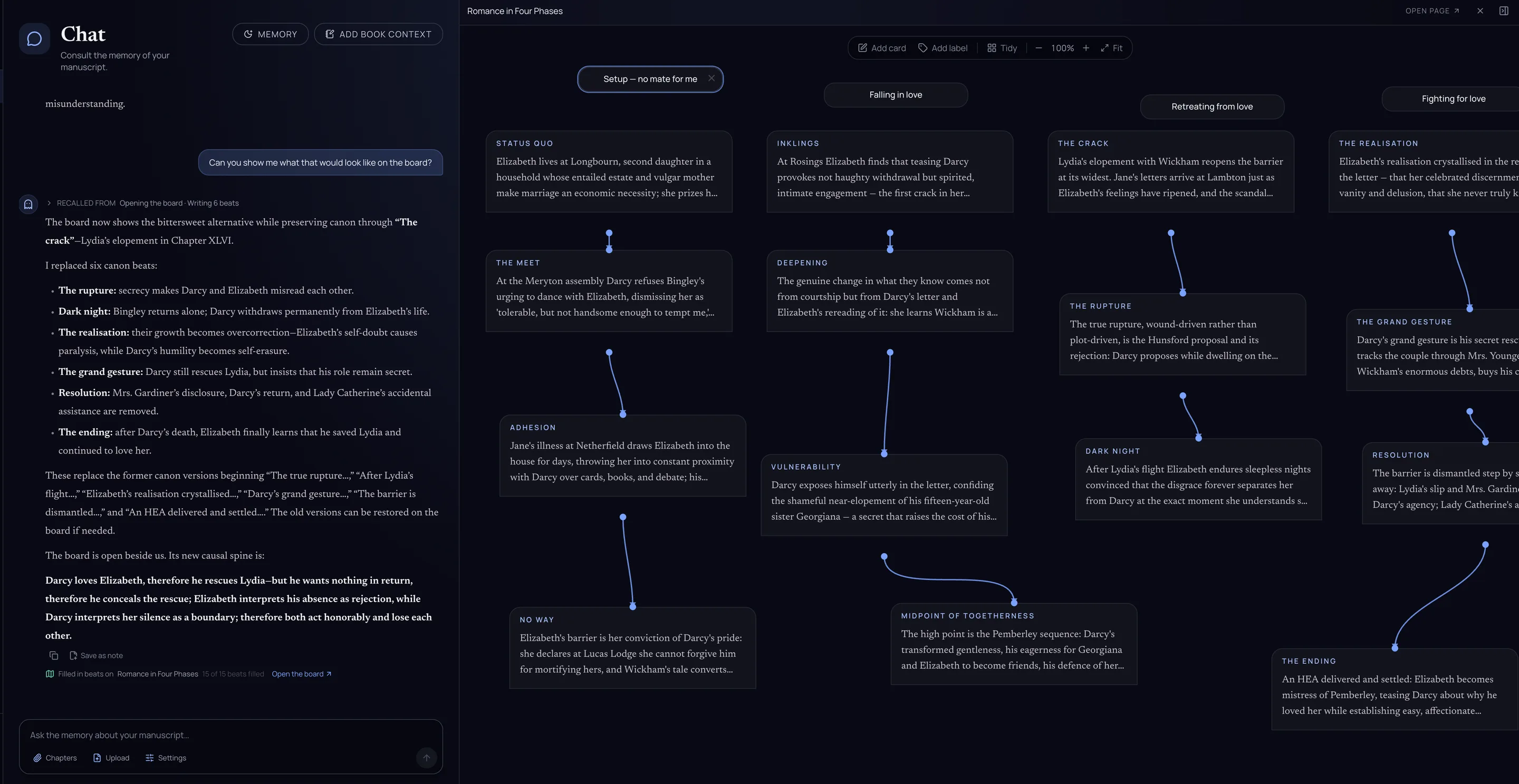
Ask about your manuscript and the editor answers from the pages themselves. When the conversation turns to a chapter, your outline or the chapter plan, it opens that page right next to itself, so you're both looking at the same thing while you work on it.
-
You ask. In your own words, about any page. It has read every chapter, so you never paste one in.
-
The page opens beside you. A chapter, a beat board, your outline or your chapter plan. Drag the divider to make room, or open it full page.
-
Every change is listed. Under the answer, each thing the chat wrote, with a link to where it landed.
Three kinds of editing, in one conversation
- 1. Chapter feedback.
- Open a chapter beside the chat and talk about it. Say "this scene" or "the second paragraph" and it knows what you mean. Ask what's working, what isn't, whether a character sounds like themselves. Want one passage changed? Say so: it rewrites that passage and leaves the rest of the page alone.
- 2. Line edits.
- A close pass over the prose itself: word choice, filtering, repetition, sentences that run long, and everything a proofread catches. The notes land under the chapter beside the chat, and nothing changes until you apply one.
- 3. Structural edits.
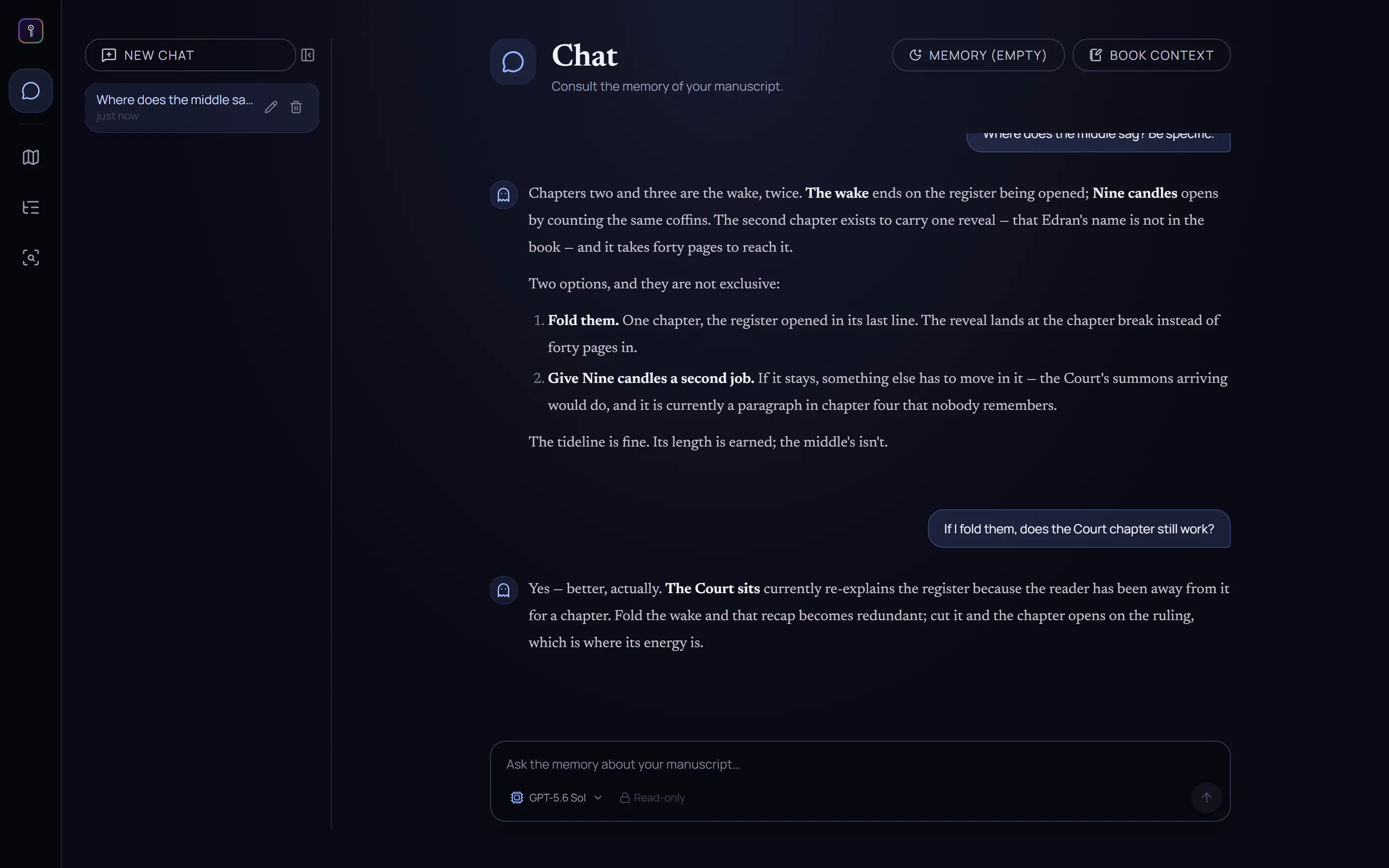
- The order and shape of chapters, asked the way you'd put it to an editor: "merge the two funeral chapters", "move the reveal earlier". It proposes the changes, you keep or skip each one, and your current draft stays as it was.
Nothing changes behind your back.
A setting in the message box decides whether the chat may write in your manuscript at all. Set it to read-only and it will talk about your chapters without touching them.
Whatever it does write opens beside the conversation, so nothing lands out of sight, and line edits never apply themselves. And if you're typing in the chapter while the chat is changing it, your words win: it re-reads the page and works from what you wrote.
How to ask for a good answer
- Say what you want.
"What do you think of chapter 5?" gets general notes. "Chapter 5 is the turn where she stops trusting him. Does it land?" gets an answer about the thing you care about.
- Name the text.
A chapter, a scene, a character, a note. "The book" is fine for questions about the whole book, but narrower is sharper.
- Say what to leave alone.
"The dialogue is where I want it, look at the description." It will take you at your word.
- Say what you want back.
A list, a verdict, three options, one question to think about. "Give me the three weakest scene transitions, worst first."
LooseIs my middle okay?
BetterChapters 10 to 16 are the middle. I'm worried nothing changes for Ines between the ball and the fire. Read them and tell me where she makes a real choice, and where she's just carried along.
A line edit you rule on.
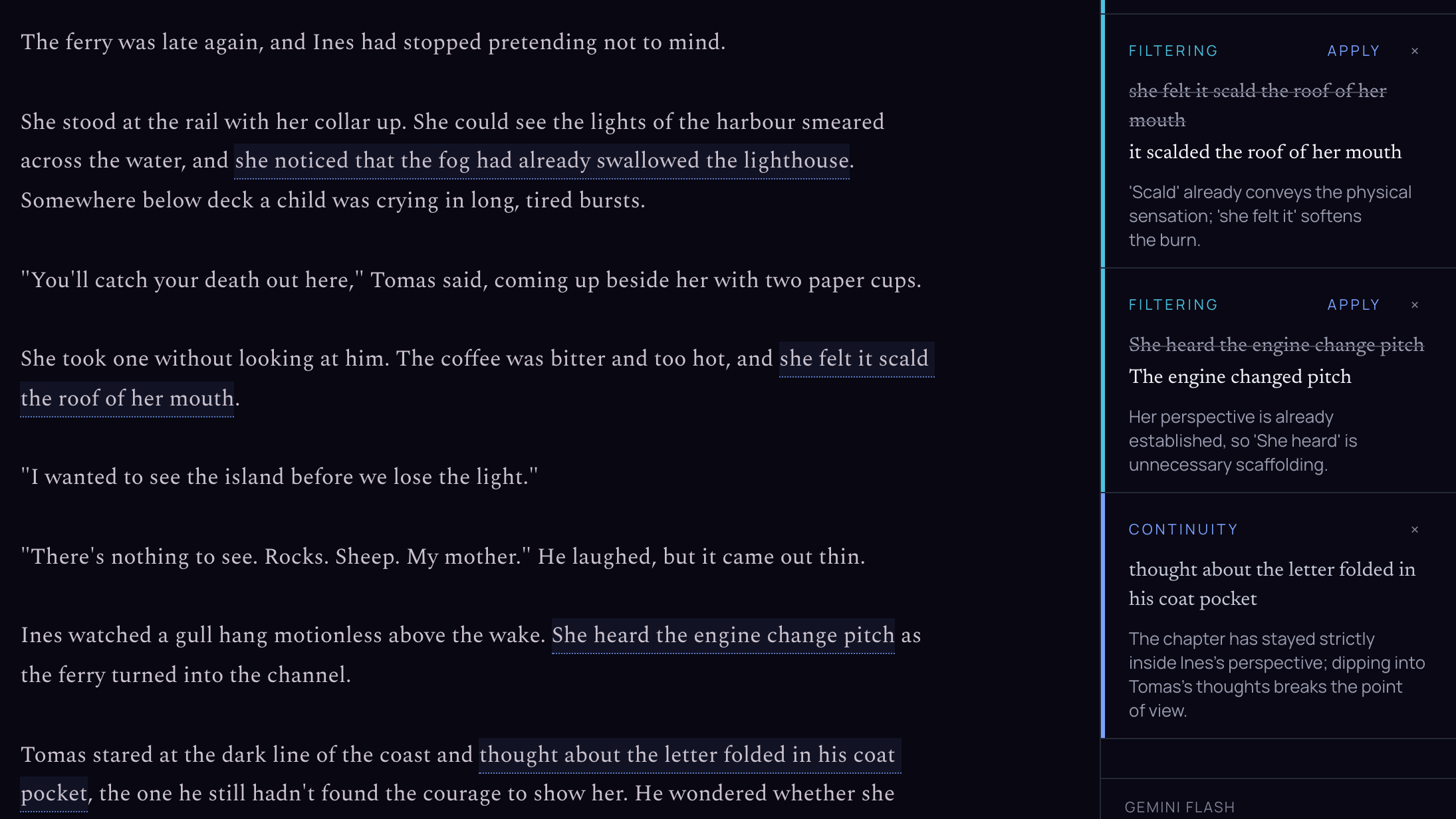
Ask for a line edit and Ghostkey reads the chapter closely: filter words, point-of-view slips, repetition, the sentence that doesn't parse. Each note quotes the passage, says what's wrong, and usually offers another wording.
-
Marked in the page. The passages under discussion are underlined in your chapter, so you judge each note in context.
-
Apply, or don't. Apply takes the new wording, ✕ keeps yours. Nothing in the chapter changes until you say so.
-
More than grammar. A slip out of your narrator's head gets a note too, not just a typo.
It edits your book, not a generic one
- Tell it what to watch for.
- Each pass takes a short brief: "watch the tense", "leave her dialect alone". Asked from the chat, it writes that brief from what you've already said.
- A style sheet that learns.
- Your spellings, your house rules, what's deliberate. Every line edit obeys it, and it picks up your book's habits as it goes.
- Your world, spelled right.
- It knows your characters and places from the world bible, so an invented name isn't "corrected" into a real word.
- Your voice stays yours.
- It respects your point of view and leaves deliberate voice alone. And if you apply a note and regret it, undo takes it back.
The whole book, read back to you.
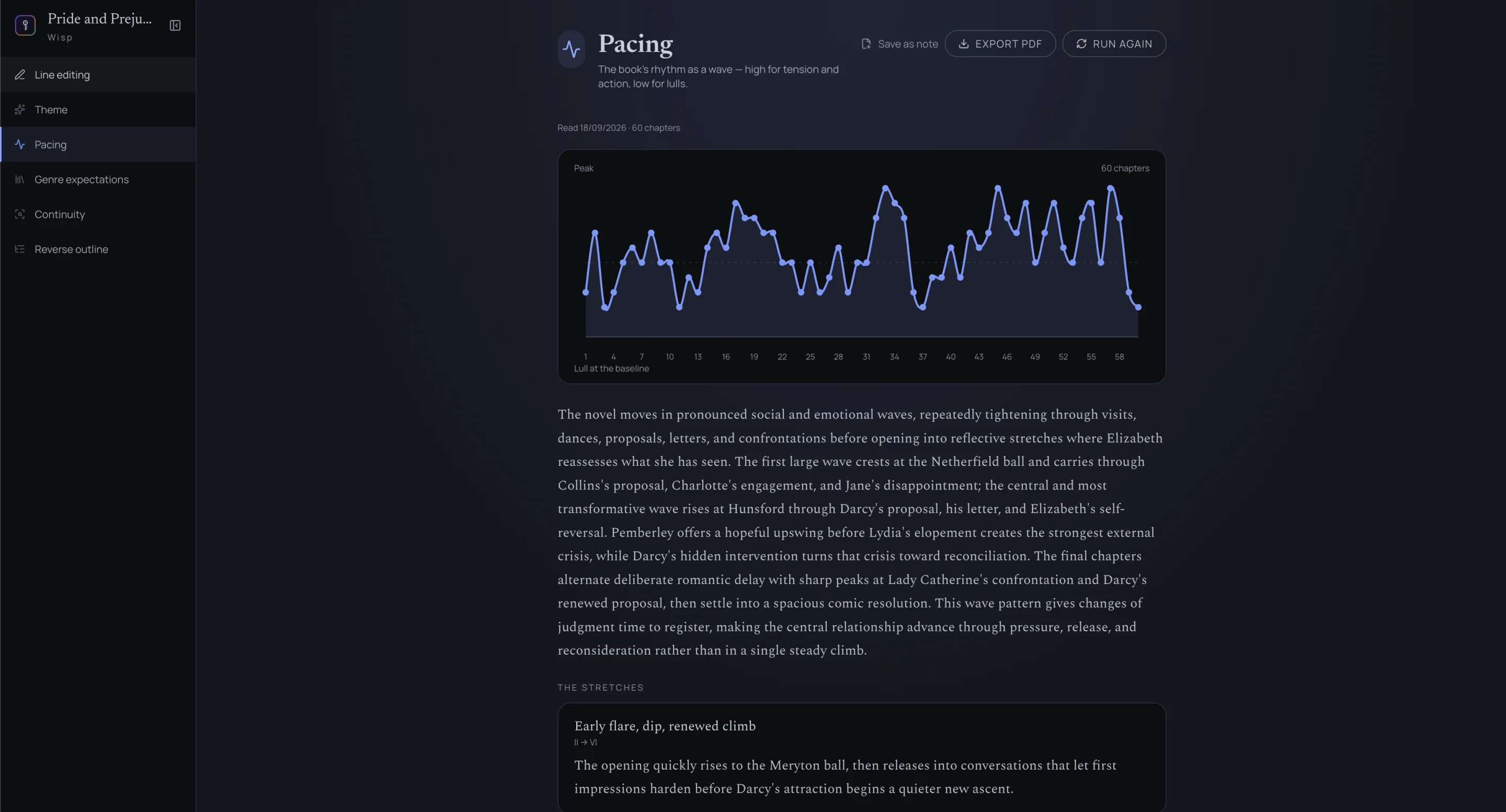
There's a point in a draft where you can't see it any more. You know every chapter too well to tell whether the middle sags, or whether the ending pays off what the opening promised. Ghostkey reads the whole manuscript and reports what it's doing, in its own terms, so you can decide whether that's what you meant.
-
The rhythm as a wave. Every chapter rated for tension, with a line saying why it sits there.
-
What the wave means. An overview of how the book moves, naming the scenes that carry it.
-
The stretches. Runs of chapters that read as one movement, and what each does to a reader: a slow build, a lull that breathes or one that stalls.
-
Yours to keep. Save a report as a note beside the book, or export it as a PDF to print or send.
Five ways to read a draft
- Pacing.
- For "it drags and I don't know where": beta readers not finishing, a draft that feels long, a climax that doesn't feel like one.
- Theme.
- The things the story keeps returning to through choices, conflicts and images, what the book says about each, and how they develop chapter by chapter.
- Genre expectations.
- The shelves a bookseller would put it on, then the expectations that matter most for each, marked met, subverted or not addressed, and why.
- Reverse outline.
- Speed-read your own book: a synopsis, an extended outline, or chapter by chapter, written from the draft as it actually stands.
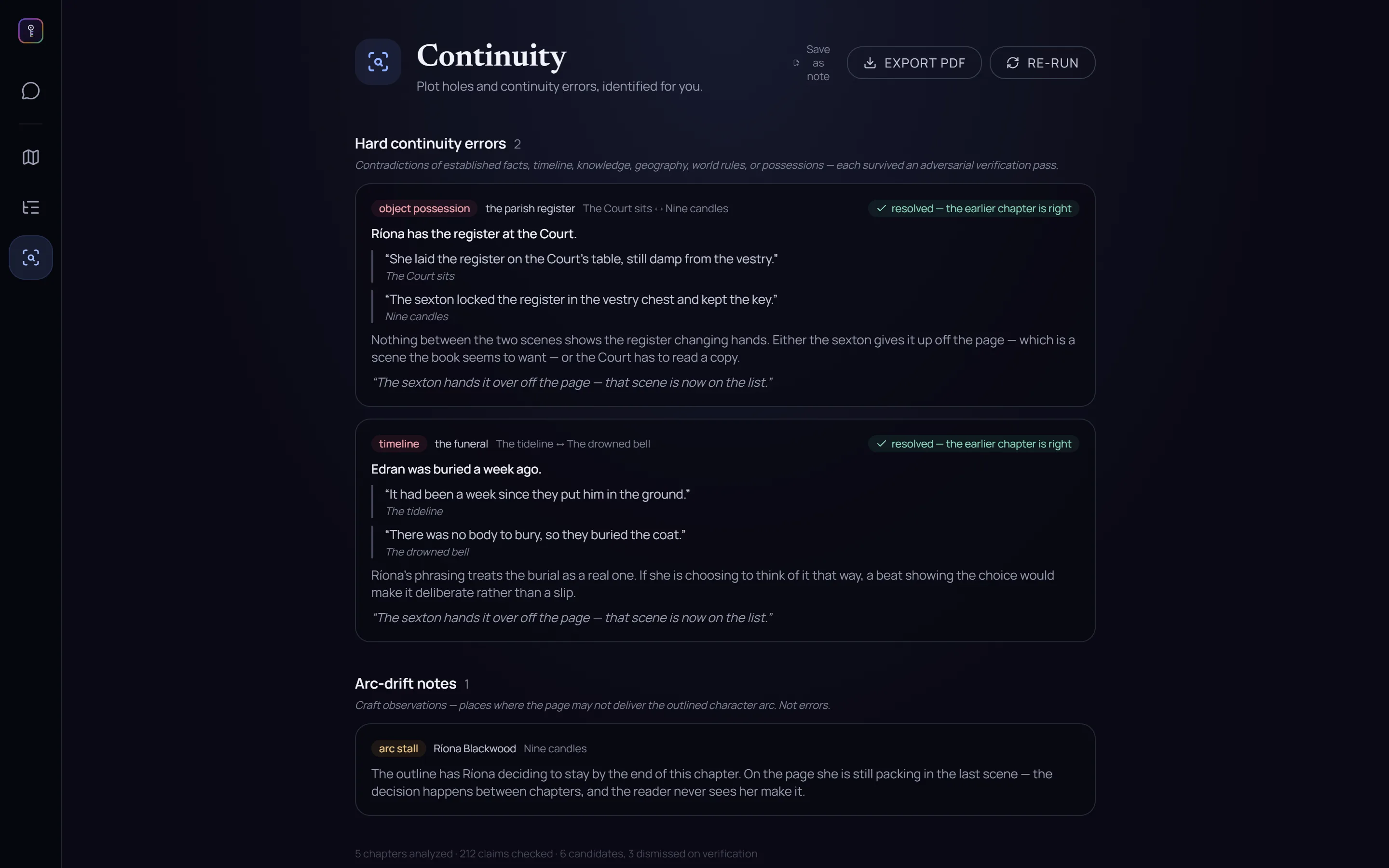
- Continuity.
- The eye colour that changed in chapter nine, the character who knows something nobody told them. Each finding quotes the passages that disagree, and you decide which ones are mistakes.
Nothing here is a grade.
A subverted expectation is a choice. A long lull is a choice. The reports say what the book does and where; what it should do is yours.
Run one, go write while it reads, and come back to it on any device. Rewrite the middle, run it again, and put the two side by side.